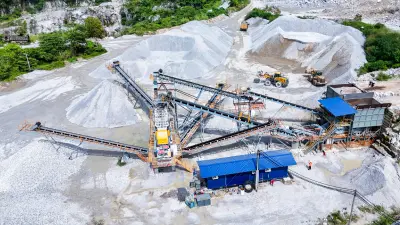
300 t/h Limestone Manufactured Sand Plant
A 300 t/h manufactured sand plant for limestone, holding fineness modulus at 2.6-2.9 and methylene blue under 1.0 so the sand can replace river sand in C30 concrete.

Any VSI can make sand. Making sand that a ready-mix plant will accept without complaint is a different problem, and it comes down to three numbers: fineness modulus between 2.6 and 2.9, methylene blue value under 1.0, and less than 10% passing 75 microns. This 300 t/h limestone plant is arranged around hitting those three numbers consistently rather than hitting peak tonnage.
What limestone gives you, and what it does not
Limestone is the easiest rock to make sand from and the hardest to make good sand from. It crushes into a cubical shape without much effort, but it also generates 12-18% fines in the 0-75 micron range, and limestone dust is exactly what makes concrete mix water demand climb. Left in the sand, those fines push the methylene blue value up and the slump down.
Two things control it: how much reduction work the VSI does, and how much of the resulting filler you take out afterwards. This plant does both.
Process flow
Feed preparation
Run-of-quarry limestone goes through a PE-600x900 jaw and a PF-1214 impact crusher to a 0-40 mm product. Two-stage preparation before the VSI matters: feeding 80 mm rock straight into a sand maker doubles the wear cost per tonne and produces a coarser, more angular sand.
Sand making
A VSI5X-1140 Sand Making Machine runs in rock-on-rock mode at 1,800 rpm, taking the 5-40 mm fraction down to 0-5 mm. Rock-on-rock rather than rock-on-anvil is the right choice for limestone: it produces a rounder particle and less iron wear, at the cost of about 15% more recirculating load.
Washing and filler control
Output goes to a spiral sand washer, then a fine sand recovery unit that captures the 0.075-0.6 mm fraction that a plain washer sends to the pond. Without that recovery unit a limestone sand plant loses 8-12% of its saleable product as sludge, and the sand that remains is coarser and harsher than it needs to be.
Equipment list
| Stage | Equipment | Qty | Power |
|---|---|---|---|
| Primary | PE-600x900 jaw crusher | 1 | 75 kW |
| Secondary | PF-1214 impact crusher | 1 | 132 kW |
| Sand making | VSI5X-1140 | 1 | 2 x 220 kW |
| Washing | XL-915 spiral sand washer | 1 | 22 kW |
| Recovery | Fine sand recovery unit | 1 | 15 kW |
| Screening | 2YKR-2160 | 2 | 2 x 30 kW |
| Dewatering | Dewatering screen | 1 | 2 x 7.5 kW |
Getting the fineness modulus right
Fineness modulus is set by the VSI rotor speed and the amount of 5-10 mm returned to the sand maker. At 1,800 rpm with a 30% recirculating load the FM lands at 2.7-2.8. Increasing recirculation to 50% pushes FM down to 2.4 but adds 18% to the power bill. The plant is set up with a variable-frequency drive on the VSI so the operator can trim FM within a shift instead of changing screens.
Water and waste
A 300 t/h sand plant needs 60-90 m3 of water per hour in closed circuit. The fines that leave the washer are 8-10% of feed by mass and can be sold as agricultural lime or used as cement raw meal, which is usually better economics than a settling pond.
Questions we are asked before quoting
Can this plant make sand for C40 and above?
Yes, with a classifier. From C40 upward the filler limit tightens and the mix design becomes sensitive to the 75 micron content. A dynamic classifier after the VSI takes the filler down to 6% and lets you blend back to target.
What is the wear cost per tonne?
In rock-on-rock mode, roughly 0.35 kg of wear parts per tonne of sand, or about USD 0.09. In rock-on-anvil mode the figure roughly doubles.
How much land does it need?
45 x 35 m including the water circuit and the sludge handling area, on ground that drains.
Other solution categories
Same engineering team, different process route.