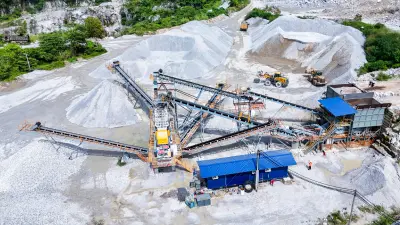
Copper Ore Flotation Line
Copper flotation for sulphide ore: roughing, scavenging and three cleaner stages, 88-93% recovery, 22-30% concentrate grade, with the flowsheet set by oxide ratio.

Copper flotation is the most widely built beneficiation circuit in the world, which means it is also the one most often copied badly. The textbook flowsheet — grind, rough, scavenge, clean three times — works on a clean chalcopyrite ore and fails on almost everything else. What actually sets the design is the oxide-to-sulphide ratio and the presence of secondary copper minerals.
Read the ore before drawing the flowsheet
Three things change the circuit completely. Free gold above 0.3 g/t needs a gravity stage ahead of flotation, because gold that enters the flotation circuit ends up distributed across every concentrate stream and is hard to account for. Secondary minerals like chalcocite and covellite float fast and need a shorter rougher residence than chalcopyrite. Oxide copper, above about 10% of total copper, does not respond to sulphide flotation at all and needs sulphidisation or a leach circuit.
| Mineral | Floatability | Circuit implication |
|---|---|---|
| Chalcopyrite | Good, slow | Standard rougher, 12-16 min |
| Chalcocite | Very fast | Short rougher, watch for over-floating pyrite |
| Covellite | Fast | As above |
| Bornite | Good | Standard |
| Oxide (malachite) | Poor | Sulphidise with NaHS, or heap leach |
Process flow
Grinding
Primary grind to 65-75% passing 75 microns. A Ball Mill in closed circuit with hydrocyclones, with a size monitor on the overflow. Every 10 microns of over-grinding costs 8% more power and produces slimes that report to the cleaner tail with the copper still in them.
Rougher and scavenger
Rougher at pH 10-10.5 with lime, 20-40 g/t of a thionocarbamate or xanthate collector, and 15-25 g/t frother. Residence 12-16 minutes, which is longer than most designs allow. Scavenger on the rougher tail with a further 10 g/t collector recovers the slow-floating portion and usually adds 3-5% recovery.
Cleaning
Three cleaner stages in counter-current configuration, with the cleaner tail returning to the head of the rougher. Regrinding the rougher concentrate to 80% passing 45 microns before cleaning is the single most effective upgrade: it lifts concentrate grade from 20-23% to 26-30% and reduces the silica penalty at the smelter.
Equipment list
| Stage | Equipment | Specification |
|---|---|---|
| Primary crushing | PE-600x900 jaw | To 80 mm |
| Grinding | Ball mill 2,100 x 4,500 + cyclone cluster | 70% passing 75 micron |
| Rougher | 8 x 20 m3 flotation cells | 14 min residence |
| Scavenger | 4 x 20 m3 cells | 8 min residence |
| Regrind | Vertical stirred mill | 80% passing 45 micron |
| Cleaner | 3 stages, 8 + 4 + 2 cells | Counter-current |
| Dewatering | 9 m thickener + plate filter press | 8-10% moisture cake |
Reagent cost, the number that decides viability
Collector 30-60 g/t, frother 20-40 g/t, lime 1-3 kg/t. At a typical 1% Cu ore the reagent cost is USD 1.20-1.80 per tonne of ore, which against a concentrate value of USD 25-40 per tonne of ore leaves a healthy margin. The killer is a high-pyrite ore where lime consumption triples to depress pyrite, and that is decided at the deposit, not the plant.
Questions we are asked before quoting
Can I leach instead of float?
Only for oxide ore or low-grade dump material. Sulphide copper leaches slowly and consumes acid; flotation is cheaper above about 0.3% Cu in sulphide form.
What does it take to get 30% concentrate?
Regrinding to 45 microns and clean ore. With high pyrite, 25-28% is a realistic ceiling without a pyrite depressant programme.
Other solution categories
Same engineering team, different process route.