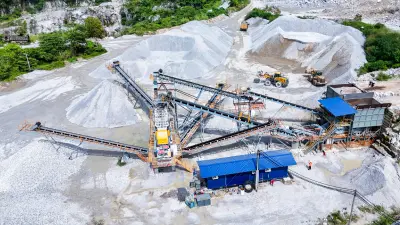
Lead-Zinc Ore Flotation Line
Selective lead-zinc flotation: galena and sphalerite separated at pH 11 with cyanide or SO2 depression, giving 55-65% Pb and 48-55% Zn concentrates at 85-90% recovery.

Lead and zinc almost always occur together, and that is the entire problem. Both are sulphides, both float with xanthate, and separating them requires suppressing one while floating the other. Get the sequence right and you produce two saleable concentrates; get it wrong and you produce one worthless bulk concentrate that no smelter wants.
Sequential or bulk
Sequential flotation floats lead first at high pH with zinc depressed, then activates and floats zinc from the tail. It gives two clean concentrates but needs tight pH control. Bulk flotation floats both together and separates them afterwards by re-floating the bulk at low pH, which handles finely intergrown ore better but adds a regrind and a second flotation circuit.
The choice is decided by liberation. If galena and sphalerite are free at 75 microns, sequential wins on cost. If they are intergrown down to 30 microns, bulk with a regrind is the only route that gives acceptable grades.
Process flow (sequential)
Lead circuit
Grind to 70% passing 75 microns in a Ball Mill. Rougher at pH 11-11.5 with lime, 40-80 g/t xanthate, 20-30 g/t frother, and zinc depressed with 100-300 g/t sodium cyanide or 500-1,500 g/t zinc sulphate plus sulphite. Three cleaners bring the lead concentrate to 58-65% Pb.
Zinc circuit
The lead tail is activated with 300-600 g/t copper sulphate at pH 10.5-11, then floated with 60-120 g/t xanthate. Four cleaner stages are typical because sphalerite flotation is less selective than galena. Final concentrate 48-55% Zn.
| Stage | Reagent | Dose | Function |
|---|---|---|---|
| Lead rougher | Lime | 2-5 kg/t | pH 11-11.5, depress pyrite |
| Lead rougher | Sodium cyanide | 100-300 g/t | Depress sphalerite |
| Lead rougher | Xanthate | 40-80 g/t | Galena collector |
| Zinc activation | Copper sulphate | 300-600 g/t | Activates sphalerite |
| Zinc rougher | Xanthate | 60-120 g/t | Sphalerite collector |
The silver bonus, and the arsenic penalty
Most lead concentrates carry 200-800 g/t silver, which is often 15-25% of the concentrate value. Silver follows galena and is recovered with it at no extra cost. Arsenic is the opposite: above 0.5% As in the concentrate, smelters apply penalties that can wipe out the margin, and the fix is a cleaner stage at higher pH rather than more grinding.
Equipment list
| Section | Equipment | Note |
|---|---|---|
| Grinding | Ball mill 1,830 x 6,400 + cyclones | 70% passing 75 micron |
| Lead flotation | Rougher 6 cells, scavenger 4, cleaners 3 stages | 18 m3 cells |
| Zinc flotation | Rougher 6 cells, scavenger 4, cleaners 4 stages | 18 m3 cells |
| Dewatering | Two thickeners + two filter presses | Separate Pb and Zn |
Questions we are asked before quoting
Why is my zinc recovery only 70%?
Usually insufficient activation or a pH that is too high in the zinc circuit. Sphalerite needs pH 10.5-11; above 11.5 it stops floating even with copper sulphate present.
Can I skip the cyanide?
Yes, with zinc sulphate plus sodium sulphite, which is now the preferred combination in most jurisdictions. It costs more in reagent but removes the cyanide handling and tailings issue.
Other solution categories
Same engineering team, different process route.