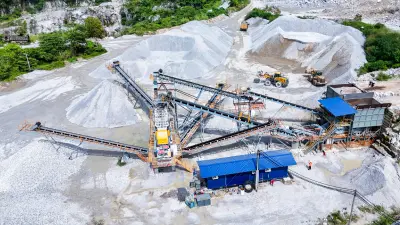
Barite Beneficiation Line
Drilling-grade barite must reach 4.20 specific gravity and stay low in soluble calcium. Jigging, tabling, and the grind for API 13A weighting agent.

Barite is bought almost entirely by the oil and gas drilling industry, and the purchase specification is a single physical number: specific gravity of at least 4.20. A barite concentrate at 4.15 is rejected, and one at 4.25 sells at the full price. Since the mineral itself is 4.48 and the gangue is 2.6-2.9, that 0.05 gap is a matter of how much quartz and clay remains, which makes this a plant that is judged on a decimal place.
The API 13A specification
| Property | Requirement | What controls it |
|---|---|---|
| Specific gravity | 4.20 minimum | Gangue content, set by separation |
| Wet screen, 325 mesh | Below 3% residue | Grinding and classification |
| Soluble alkaline earth | Below 250 mg/kg | Washing, ore mineralogy |
| Water soluble salts | Below 1% | Washing |
| Moisture | Below 1% | Drying |
Process flow
Gravity concentration
Barite at 4.48 against quartz at 2.65 is an easy gravity separation when the liberation is coarse. A trommel or screen splits the feed at 10 mm, a jig treats the 2-10 mm fraction and recovers 75-85% of the barite at 4.2-4.3 specific gravity, and a shaking table cleans the jig concentrate to 4.3-4.35. For finer liberation, spiral concentrators handle 0.1-1 mm economically.
Iron removal
Barite used in drilling mud must not carry iron sulphides, which react with the mud and with the drill string. A low-intensity magnetic separator on the table concentrate removes pyrite and marcasite, and in many cases a small amount of siderite. For white barite used as a paint filler, a high-intensity pass plus acid leaching is needed.
Grinding to 325 mesh
The drilling specification is 97% passing 325 mesh, which is a fine grind on a dense and abrasive material. A Raymond Mill with a classifier handles 5-15 t/h; a ball mill in closed circuit is used for larger tonnages. Barite at Mohs 3-3.5 is not hard, but it is heavy, so the mill power per tonne is high and the classifier has to be sized for a dense product that settles quickly.
Washing for soluble salts
Barite from a carbonate-hosted deposit can carry soluble calcium and magnesium that exceed the 250 mg/kg limit. A simple wash with fresh water after grinding, followed by filtration and drying, brings it into specification. For a high-salinity deposit, this step is the difference between selling and not selling.
Equipment list
| Stage | Equipment | Specification |
|---|---|---|
| Primary | Jaw crusher | To 40 mm |
| Classification | Vibrating screen | 10 mm and 2 mm cuts |
| Rougher | Jig, 2 cells | 2-10 mm fraction |
| Cleaner | Shaking table | To 4.30 specific gravity |
| Iron removal | Drum magnet, 1,500 gauss | Pyrite out |
| Grinding | Raymond mill 5R | 10 t/h at 325 mesh |
| Washing | Filter + fresh water wash | Soluble salts below 1% |
| Drying | Rotary dryer | Below 1% moisture |
The two other markets
Paint and plastic filler barite needs 98% BaSO4, whiteness above 90, and a top cut of 10-20 micron — a different plant with a fine grinding circuit and often a bleaching step. Radiological barite for concrete shielding is bought on density alone and needs only coarse crushing. Both pay better than drilling grade per tonne, and both require the ore to be white and low in iron, which is a deposit property.
Questions we are asked before quoting
Why is my concentrate at 4.15?
Almost always fine intergrowth with quartz that was not liberated. Regrind the middlings to 0.3 mm and re-table them; the alternative is to accept a lower-gravity product at a discount.
Can I use flotation for barite?
Yes, with a fatty acid or a sulphonate collector, and it is used for finely disseminated ores. It is more expensive than gravity and the product usually filters badly, so gravity is tried first.
Other solution categories
Same engineering team, different process route.