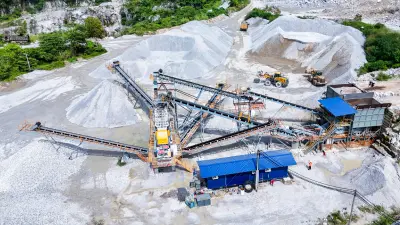
Gold Ore CIL Plant (Carbon-in-Leach)
Carbon-in-leach cyanidation for small and medium gold plants: carbon added directly to the leach tanks, fewer tanks, 90-95% recovery and lower capital cost than CIP.

CIL puts the carbon in the leach tank rather than in a separate adsorption train. That one decision removes four tanks and one pumping stage from the flowsheet, which is why almost every gold plant under about 300 t/d is built this way. The trade-off is that you cannot separately optimise leaching and adsorption, and the carbon sees a more aggressive chemical environment.
How CIL differs in practice
In a CIP circuit the pulp is leached to completion first, then contacted with carbon. In CIL both happen at once, and the carbon mops up dissolved gold as it forms, which keeps the dissolved gold concentration low and drives the leach reaction forward. That is why CIL often reaches the same recovery in a shorter total residence time.
The catch is that the carbon is exposed to the full leach chemistry. In an ore with high silver or with organic carbon, the carbon loads with the wrong things and elution becomes difficult.
Process flow
Grinding circuit
A ball mill in closed circuit with a hydrocyclone, targeting 80% passing 75 microns. For a 100 t/d plant a 900 x 1,800 mill at 22 kW is typical. The classifier overflow goes straight to the first CIL tank through a trash screen, which catches wood, plastic and blasting wire that would otherwise blind the carbon screens.
CIL tanks
Five tanks in series, each with a 45-degree pitched blade impeller at 60-80 rpm and a peripheral carbon retention screen. The first two tanks run without carbon and act as pre-leach, which improves overall recovery by 1-2% by ensuring gold is dissolved before adsorption begins. Total residence time 20-24 hours.
Carbon handling
Carbon is advanced from the last tank to the first every 24 hours by airlifting, counter-current to the pulp. Loaded carbon at 2,500-5,000 g/t is screened out at the first tank and sent to elution. Fresh carbon is added at the last tank.
Equipment list
| Section | Equipment | Note |
|---|---|---|
| Crushing | PE-250x400 jaw + hammer mill | To 10 mm |
| Grinding | Ball mill 900 x 1,800 | 80% passing 75 micron |
| Leaching | 5 x 120 m3 CIL tanks | 20-24 h residence |
| Carbon | 6x12 coconut carbon, airlift | 15-20 g/L density |
| Elution | 500 kg batch column | 140 C, 3% NaOH + 3% NaCN |
| Recovery | Electrowinning + 50 kg induction furnace | Doré 85-90% Au |
| Cyanide destruction | SO2/air reactor | Tailings under 50 ppm WAD CN |
Operating parameters that matter
pH 10.5-11.0, dissolved oxygen above 6 mg/L, cyanide 300-600 ppm in the first tank falling to 100-150 ppm at the last. Carbon concentration 15-20 g/L. Temperature matters more than most operators expect: below 15 C the leach rate halves, and in cold climates the tanks need insulation or preheating.
Questions we are asked before quoting
Can I add a CIL train to an existing plant?
Yes if there is tank space and a tailings line. The usual retrofit is to convert existing leach tanks by adding carbon retention screens and an airlift, which costs roughly 30% of a new train.
What is the smallest viable CIL plant?
30 t/d with a batch elution column. Below that the reagent handling and tailings treatment costs dominate and a gravity-only plant is usually better.
Other solution categories
Same engineering team, different process route.