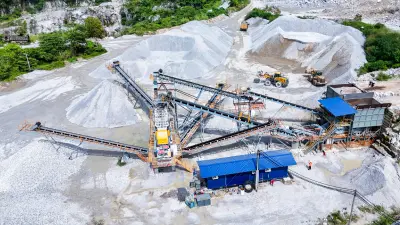
Gold Ore CIP Plant (Carbon-in-Pulp)
Carbon-in-pulp cyanidation for oxide and free-milling gold ores: 8-24 hour leach, carbon in the pulp, 92-96% recovery from a 2-8 g/t feed at 300-800 t/d.

CIP suits one kind of ore very well: free-milling or lightly refractory gold that leaches quickly, with little silver and no preg-robbing carbon in the ore itself. When those conditions hold it is the cheapest route per recovered ounce. When they do not, it is the most expensive mistake in gold processing, because the carbon adsorbs gold from the pulp and from the ore indiscriminately.
When CIP is the right route
Three tests decide it. First, a bottle roll leach: if 90% of the gold dissolves in 24 hours at 1,000 ppm cyanide, the ore is free-milling and CIP will work. Second, a preg-robbing test: if the ore contains graphitic carbon or active clays, dissolved gold will be absorbed onto the ore instead of the carbon and recovery collapses. Third, a silver assay: high silver consumes cyanide and loads the carbon, which changes the elution design.
| Ore type | CIP suitability | Reason |
|---|---|---|
| Oxide, free milling | Excellent | Fast leach, no interference |
| Quartz vein with sulphides | Fair | Needs finer grind, longer leach |
| Carbonaceous / graphitic | Poor | Preg-robbing, use flotation or resin |
| Arsenopyrite locked | Poor | Gold encapsulated, needs roasting or POX |
| High silver | Fair | Carbon loading, higher elution cost |
Process flow
Comminution
A jaw crusher reduces to 12 mm in a small plant; 300 t/d typically uses a PE-400x600 plus a Ball Mill at 75% passing 75 microns. Grind size is the single biggest lever on recovery. Going from 100 to 75 microns typically gains 2-4% recovery and costs 15% more grinding power, which almost always pays at gold prices.
Leaching
Six to eight agitated tanks in series, each 4-6 hours of residence. pH is held at 10.5-11.0 with lime, because below 10 the cyanide forms HCN gas and above 11 the leach rate falls. Dissolved oxygen is kept at 6-8 mg/L by sparging; a common failure in tropical plants is assuming the pulp is aerated when it is not.
Carbon adsorption
Activated coconut-shell carbon at 10-25 g/L is moved counter-current through the last four tanks. Carbon loading reaches 3,000-6,000 g/t before it goes to elution. The screen size matters: 6 x 12 mesh carbon with 1 mm slots retains the carbon while passing the pulp, and a worn screen is the most common source of gold losses in a CIP circuit.
Equipment list
| Section | Equipment | Key parameter |
|---|---|---|
| Crushing | PE-400x600 jaw | 12 mm product |
| Grinding | Ball mill 1,500 x 3,000 | 75% passing 75 micron |
| Thickening | 6 m high-rate thickener | 45-50% solids to leach |
| Leaching | 6 x 500 m3 agitated tanks | pH 10.5-11, DO 6-8 mg/L |
| Adsorption | 4 tanks with 6x12 carbon | 10-25 g/L carbon density |
| Desorption | Elution column, 1.5 t batch | 150 C, 3% NaOH, 3% NaCN |
| Recovery | Electrowinning cell + smelting furnace | Doré bar 85-92% Au |
Reagent consumption, which sets the operating cost
At 300 t/d expect 0.3-0.6 kg NaCN per tonne, 2-4 kg lime per tonne, 0.6-1.2 kg zinc (if using Merrill-Crowe instead of electrowinning). Cyanide is 55-65% of the reagent bill, and most of it is consumed by copper, iron and sulphide minerals rather than by gold. An ore with 0.3% copper will double cyanide consumption without warning.
Tailings and the environmental side
CIP tailings carry 50-200 ppm weak acid dissociable cyanide. This must be destroyed before the tailings dam, usually with SO2/air or hydrogen peroxide. A 300 t/d plant needs an 8 m3 destruction reactor and about 2 kg SO2 per tonne of tailings. This is not optional in any jurisdiction that permits cyanidation at all.
Questions we are asked before quoting
Why CIP and not CIL?
CIP separates leaching from adsorption, which lets you run a higher carbon concentration and get a cleaner eluate. CIL combines them in one train and saves tanks. Below 300 t/d CIL is usually cheaper; above that CIP gives better control.
What recovery can I expect?
92-96% for a free-milling oxide ore at 75 micron grind. Below 90% usually means the gold is locked in sulphides and needs a different route.
Other solution categories
Same engineering team, different process route.