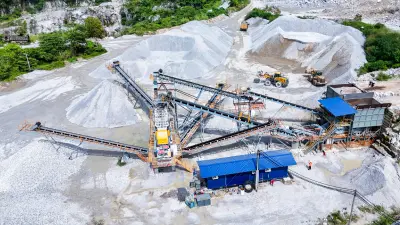
Construction and Demolition Waste Recycling Plant
Turning demolition rubble into certified recycled aggregate: the two-stage crushing flowsheet, the wind sifter that removes the light fraction, and why washing decides the product grade.

Demolition waste is not one material. A single skip can contain concrete at 40 MPa, brick, gypsum plasterboard, timber, plastic, and rebar. The plant's job is to separate these into streams that someone will buy, and the difference between a plant producing a 5 USD per tonne landfill-avoidance product and one producing a 15 USD per tonne certified aggregate is the amount of sorting and washing downstream of the crusher.
Three product grades and what each needs
| Grade | Use | Processing required | Value index |
|---|---|---|---|
| Grade 3 | Landfill capping, fill | Single pass crush, no sorting | 1.0 |
| Grade 2 | Road sub-base, pipe bedding | Two-stage crush, magnetic, wind sift | 1.8-2.2 |
| Grade 1 | Structural concrete, asphalt | Above plus washing and screening | 2.5-3.5 |
Most plants are built for Grade 2 and then discover that the market wants Grade 1. The extra cost of building the washing section at the start is 15% of the plant; retrofitting it is 30% and requires space that is not available.
Process flow
Pre-sorting and the gypsum problem
Manual or excavator pre-sorting removes timber, plastic and, most importantly, gypsum plasterboard. Gypsum in recycled aggregate is a serious defect: sulphate above 0.8% causes ettringite expansion in concrete, and a single pallet of plasterboard in 500 tonnes of rubble is enough to fail the sulphate test. A dedicated gypsum separation station at the receiving bay costs little and prevents a product recall.
Crushing
A jaw crusher takes the 0-800 mm feed down to 80 mm with an overbelt magnet downstream to pull rebar. The secondary is normally an impact crusher, because the impact action breaks the mortar off the original aggregate — which is what raises the quality of the recycled product — whereas a cone crusher tends to break through the particles and leave mortar attached.
Light fraction removal
A wind sifter after screening blows the lightweight contaminants — wood, plastic, insulation, paper — out of the 5-40 mm stream. One pass removes 80-90%; two passes in series reach 95%. This is the cheapest single investment in product quality, and it is the section most often omitted to save capital.
Washing, for Grade 1
A water bath with a rising current separates the remaining light contaminants and washes off the fines and soluble sulphates. Water is recirculated through a clarifier; make-up is 0.3-0.5 m3 per tonne. The washed product has a water absorption of 4-6% against 8-12% unwashed, which is the number that decides whether a concrete producer will use it.
Equipment list
| Stage | Equipment | Specification |
|---|---|---|
| Feeding | Apron feeder + vibrating grizzly | 800 mm feed |
| Primary | Jaw crusher, hydraulic release | To 80 mm |
| Metal | Overbelt magnet | 1,200 gauss |
| Secondary | Impact crusher | To 40 mm |
| Screening | Vibrating screen, 3 decks | 0-5, 5-20, 20-40 mm |
| Light fraction | Wind sifter, 2 stages | Removes wood and plastic |
| Washing | Water bath + fines clarifier | Closed loop, 0.4 m3/t |
| Dust control | Water sprays, fog cannons | Crushing and transfer points |
The business model that works
A C&D plant is paid twice: a gate fee to accept the waste, and a price for the aggregate. The gate fee is 30-80 USD per tonne in most markets and is the larger revenue line. That changes the design priority — throughput and availability matter more than product grade, and a plant that cannot accept material fast enough during a demolition project loses the gate fee to a competitor with a bigger tip bay. Size the receiving area, not just the crusher.
Questions we are asked before quoting
What proportion of the feed becomes product?
70-85% by mass for clean demolition rubble, 55-70% for mixed skip waste. The rest is metal (recycled), light fraction (sent for energy recovery) and fines (landfill or cement kiln).
Can recycled aggregate be used structurally?
Yes, up to 30% replacement of coarse aggregate in C30 concrete under most codes, with a strength penalty of 5-10%. Above that the water absorption and the residual mortar become hard to compensate.
Other solution categories
Same engineering team, different process route.