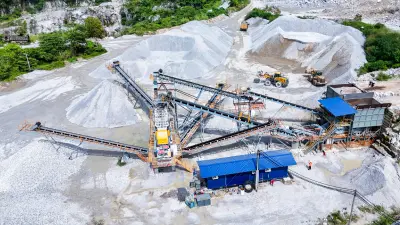
Slag and GGBS Grinding Line
Granulated blast furnace slag ground to 420-450 m2/kg specific surface on a vertical roller mill, with the drying capacity to handle 10-15% feed moisture.

Slag is the hardest common material to grind and the most valuable when you do it well. Granulated blast furnace slag at 420-450 m2/kg sells as a cement replacement at 60-80% of clinker value while consuming 40% of the energy, which is why every cement producer with access to a steel plant has looked at building a slag mill. The obstacle is that slag is abrasive, wet, and grinds slowly.
Why a Vertical Roller Mill, not a Ball Mill
A ball mill grinding slag to 420 m2/kg consumes 55-70 kWh per tonne. A vertical roller mill does it at 38-45. At 100,000 tonnes a year that difference is worth more than the capital cost gap. The vertical mill also dries the feed in the same operation, which matters because slag arrives at 10-15% moisture and a ball mill circuit would need a separate dryer.
| Parameter | Vertical roller mill | Ball mill |
|---|---|---|
| Power at 420 m2/kg | 38-45 kWh/t | 55-70 kWh/t |
| Feed moisture | Up to 15% with hot gas | Needs pre-drying |
| Wear parts | Tyres and table, 6-8 months | Balls and liners, 8-12 months |
| Product shape | Slightly broader PSD | Narrower PSD, better strength |
The one advantage a ball mill retains is a narrower particle size distribution, which gives marginally better 28-day strength at the same Blaine. Where the cement is sold on strength rather than on Blaine, that can justify the power penalty. For most markets it does not.
Process flow
Feed and drying
Slag from the steel plant is stockpiled under cover if possible. A weigh feeder delivers it to the mill at a controlled rate; hot gas from a hot gas generator at 250-350 C enters the mill and evaporates the moisture in the grinding zone. The mill outlet temperature is held at 90-100 C — above that the gypsum (if added) starts to dehydrate, below 80 C the product carries moisture into the silo and sets there.
Grinding and classification
The vertical roller mill runs with a bed thickness of 25-35 mm and a grinding pressure of 8-12 MPa. Slag is harder than clinker, so the pressure is higher and the wear rate on tyres is roughly double. A dynamic classifier on top controls the 45 micron residue at 2-4%, which corresponds to 420-450 m2/kg Blaine.
Product handling
Air slide conveying to a silo, then bulk tanker loading or bagging. Slag powder is more cohesive than cement and bridges in silos more readily; the silo needs air pads and a 60-degree cone.
Equipment list
| Stage | Equipment | Specification |
|---|---|---|
| Feeding | Weigh feeder 150 t/h | Plus metal detector |
| Mill | Vertical roller mill, 4,200 mm table | 120 t/h at 420 m2/kg |
| Hot gas | Hot gas generator, coal or gas | 350 C at mill inlet |
| Classifier | Dynamic, high efficiency | 45 micron residue 2-4% |
| Filter | Pulse jet bag filter | 99.9%, 10 mg/m3 |
| Conveying | Air slide + bucket elevator | To 5,000 t silo |
The metallurgy of slag, briefly
Not all slag grinds to the same strength. The reactivity depends on the glass content, which depends on how the slag was quenched at the steel plant: water-granulated slag is glassy and reactive, air-cooled slag is crystalline and nearly inert. Before designing a plant, get a glass content measurement. Below 85% glass the product will not reach the strength index that the market expects, whatever the Blaine.
Questions we are asked before quoting
Can I grind slag and clinker in the same mill?
Yes, but not at the same time without cleaning. The grindability difference is large and a mixed product has unpredictable strength. Most plants run slag campaigns and clinker campaigns separately.
What capacity do I need to be viable?
Above 300,000 t per year the economics are solid. Below 150,000 t per year the fixed costs — especially the hot gas system and the filter — dominate.
Other solution categories
Same engineering team, different process route.