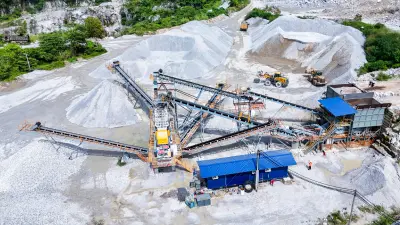
Steel Slag Processing and Metal Recovery Line
Converter slag carries 15-25% metallic iron and a free lime problem that cracks every road built on untreated slag. Multi-stage crushing, magnetic recovery and the ageing step that fixes volume stability.

Steel slag is a low-grade ore and a construction aggregate at the same time, and the plant has to serve both. Crush and magnetically separate it and you recover 85-90% of the metallic iron, which is worth more than the aggregate. But the residue still contains free CaO that hydrates and expands by 10% over months, and an aggregate that expands is not an aggregate — it is a lawsuit waiting for a road to be built on it.
Why steel slag is different from blast furnace slag
| Property | Converter steel slag | Blast furnace slag |
|---|---|---|
| Metallic iron | 15-25% | Below 1% |
| Free CaO | 3-8% | None |
| Hardness | Very high, abrasive | Glassy, friable |
| Use as SCM | Limited, low reactivity | Excellent, 420 m2/kg |
| Best route | Crush, magnet, age, sell as aggregate | Grind to GGBS |
Steel slag does not make good cement replacement because its glass content is low and its free lime causes expansion in concrete. It makes good road base, good asphalt aggregate, and good return feed to the steel plant after metal recovery. Design for that, not for GGBS.
Process flow
Primary crushing and first metal removal
Slag lumps up to 800 mm come out of the pit with a steel skull embedded in them, so the primary crusher needs a heavy-duty jaw crusher with a hydraulic release that lets an uncrushable pass rather than destroying the frame. A suspension magnet over the discharge belt pulls out the large pieces of scrap before they reach the secondary crusher, where they cause the majority of breakdowns.
Liberation and secondary recovery
The slag is reduced to below 30 mm in a cone crusher and screened at 10 mm. Magnetic separation at each size fraction recovers iron that is only liberated at finer sizes. Three stages — overbelt at 80 mm, drum at 30 mm, and drum at 10 mm — typically lift recovery from 65% to 88%. The recovered metal at 85-92% Fe returns to the steel plant as coolant scrap.
Ageing: the step that is skipped and should not be
Treated slag must be aged before it is sold as aggregate. Two methods work. Outdoor ageing in a turned windrow for 6-12 months relies on rain and atmospheric moisture and is cheap but needs land and time. Steam ageing in a pressure vessel at 2-3 bar for 6-12 hours converts the free lime in a day and gives a product with under 1.5% free CaO. A plant selling into structural concrete or asphalt cannot rely on outdoor ageing in a dry climate.
Equipment list
| Stage | Equipment | Specification |
|---|---|---|
| Feeding | Apron feeder + grizzly | 600 t/d, 800 mm lumps |
| Primary | Jaw crusher, hydraulic release | To 120 mm |
| Metal recovery 1 | Overbelt magnet | Above 80 mm |
| Secondary | Cone crusher | To 30 mm |
| Metal recovery 2 and 3 | Drum magnets, 2 units | 30 mm and 10 mm fractions |
| Screening | Vibrating screen, 3 decks | 0-5, 5-10, 10-30 mm |
| Ageing | Steam vessel or turning yard | Free CaO below 2% |
The economics of a slag plant
Two revenue lines. Metal recovery at 150-200 kg per tonne of slag, valued at 70-80% of scrap price. Aggregate at 0.9-1.0 tonnes per tonne of slag. The processing cost is 4-7 USD per tonne, dominated by power for crushing and by wear parts — slag is abrasive and jaw plates last 600-1,000 hours. Plants that only recover metal and dump the tailings leave 60% of the revenue in the pit.
Questions we are asked before quoting
Can I grind steel slag into cement?
You can grind it, and it is done for low-grade blended cement at 350-400 m2/kg, but the free lime must be below 2% first and the strength contribution is only 60-70% of GGBS at the same fineness.
How much land does ageing need?
Outdoor ageing needs about 0.5 hectares per 100,000 tonnes per year of throughput with 6-12 months of residence. Steam ageing needs a vessel and a day.
Other solution categories
Same engineering team, different process route.