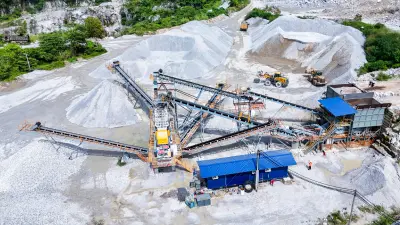
Copper Slag Recovery and Beneficiation Line
Smelter slag still holds 0.8-1.5% copper. Crushing, grinding and flotation recover 90-95% of it, and the tailings then become a saleable abrasive and ballast.

Every tonne of copper concentrate smelted produces two to three tonnes of slag carrying 0.8-1.5% copper. At a copper price above 8,000 USD per tonne, that slag is a 100 USD per tonne ore body sitting next to the smelter, already mined, already crushed by the furnace, and free of mining cost. Slow-cooled slag is also coarsely crystalline, which means the copper minerals have grown into grains that liberate easily.
Slow cooling is the whole game
Slag that is quenched fast becomes glass and the copper droplets stay locked at 5-20 micron, which is a flotation problem nobody solves economically. Slag cooled slowly in a pit over 24-48 hours crystallises into fayalite and magnetite with copper sulphide grains of 50-200 micron. The difference in recovery between the two is 40 percentage points.
| Cooling | Copper grain size | Grind required | Recovery |
|---|---|---|---|
| Water quench | 5-20 micron | Below 20 micron | 55-70% |
| Pit, slow air cool | 50-200 micron | 75-150 micron | 90-95% |
| Launder with heat recovery | 80-250 micron | 100-150 micron | 90-95%, plus steam |
Process flow
Crushing and grinding
Slag lumps are hard and abrasive: a jaw crusher to 100 mm, a cone crusher to 15 mm, then a ball mill in closed circuit with a classifier to 80% passing 75 micron. Wear is the dominant cost: liners and balls last 40-50% as long as they would on a typical porphyry ore, and the mill power is 10-15% higher because slag is dense at 3.4-3.8 g/cm3.
Flotation
Rougher flotation with xanthate at pH 10-11, two stages of cleaning and one scavenger. Copper in slag is mostly present as fine matte droplets and as dissolved copper in the glassy phase, so the recovery ceiling is set by the cooling history rather than by the reagent scheme. Concentrate at 18-25% Cu returns to the smelter, which closes the loop with almost no transport cost.
Tailings as a product
After copper removal the tailings are an iron silicate with 40-45% Fe, and they sell as blasting abrasive (a direct substitute for copper slag abrasive, which is the same material), as rail ballast, and as a fine aggregate for asphalt. An operation that treats tailings as waste disposes of a product.
Equipment list
| Stage | Equipment | Specification |
|---|---|---|
| Primary | Jaw crusher | To 100 mm, 500 t/d |
| Secondary | Cone crusher | To 15 mm |
| Grinding | Ball mill 2.4 x 8 m + classifier | 80% below 75 micron |
| Flotation | Rougher, scavenger, 2 cleaners | pH 10-11 |
| Dewatering | Thickener + filter press | Concentrate 12% moisture |
| Tailings | Dewatering screen or filter | For sale as abrasive |
Magnetite is a second revenue stream
Copper slag contains 8-15% magnetite, and much of it is liberated at the same grind. A low-intensity magnetic separation stage downstream of the copper circuit recovers a magnetite concentrate at 60-65% Fe which sells to the cement industry for heavy-media and iron correction, or back to the concentrator. The capital is one drum separator; the payback is usually under a year.
Questions we are asked before quoting
What copper grade in slag makes recovery worthwhile?
0.5% is the practical floor at current prices and power costs. Below that the grinding energy exceeds the metal value.
Can I float slag and ore in the same circuit?
Not recommended. The density difference changes the pulp rheology and the reagent consumption, and slag contaminates the ore concentrate with silica.
Other solution categories
Same engineering team, different process route.