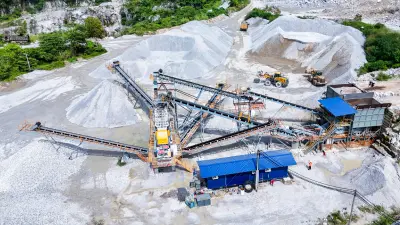
Bentonite and Kaolin Grinding Line
Raw bentonite arrives at 25-35% moisture and cannot be ground wet. The drying-grinding balance, sodium activation, and the fineness that decides drilling-grade value.

Clay minerals break the usual grinding rules because they arrive wet. Bentonite comes out of the pit at 25-35% moisture and kaolin at 15-25%, and neither can be fed to a mill at that moisture — the material smears on the grinding surfaces and the mill blinds within minutes. The plant is a drying plant with a mill attached, and the dryer sizing decides the capacity.
Drying before grinding, or drying while grinding
Two architectures, and the choice depends on how wet the feed really is.
| Route | Feed moisture | Capital | Notes |
|---|---|---|---|
| Rotary dryer + mill | Up to 35% | Higher | Independent control, handles sticky feed |
| Hot-gas grinding mill | Up to 12% | Lower | One machine, but capacity drops with moisture |
| Rotary dryer + air-swept mill | 15-25% | Middle | Most common for bentonite |
For bentonite above 20% moisture, a separate rotary dryer is almost always right. Grinding mills that claim 15% moisture capacity are quoting a best case on a dry day; on a wet week the throughput falls by half and the bag filter plugs.
Process flow
Sodium activation, if the product is drilling grade
Calcium bentonite has to be converted to sodium bentonite to develop the swelling and viscosity that drilling mud requires. The activation is done by adding 2-4% soda ash to the moist clay and allowing it to react for several days in a stockpile, or in a heated mixer for a few hours. This step happens before drying. A plant that grinds calcium bentonite and sells it as drilling mud will be rejected on the first mud balance test, and no amount of fine grinding fixes the chemistry.
Drying
A rotary dryer with a co-current flow and lifters, inlet gas at 500-600 C, outlet material at 100-120 C. Bentonite is thixotropic and forms balls in a dryer if the feed is too wet or the lifters are wrong; the fix is a combination of lifters and a short residence time, not a bigger dryer. Over-drying above 130 C reduces the swelling capacity of sodium bentonite permanently, which is a quality loss that cannot be recovered.
Grinding and classification
A Raymond or ring-roll mill with an integral classifier covers the 200-325 mesh range that most of the market buys. Drilling-grade bentonite is specified at 200 mesh with less than 2.5% residue; foundry-grade at 200 mesh with a controlled green strength; kaolin for paper coating needs 400 mesh and above with a brightness specification that depends on the deposit rather than the mill. For 400 mesh and finer, an high-pressure suspension mill raises capacity at the same fineness.
Equipment list
| Stage | Equipment | Specification |
|---|---|---|
| Crushing | Roll crusher or hammer mill | To 25 mm |
| Activation | Soda ash dosing + mixer | 2-4% by weight |
| Drying | Rotary dryer, 1.8 x 12 m | 35% to 8% moisture |
| Grinding | Raymond mill, 4R or 5R | 12 t/h at 200 mesh |
| Classification | Integral, adjustable | 200-325 mesh |
| Collection | Pulse jet bag filter | 99.9%, 20 mg/m3 |
| Packing | Valve packer, 25 kg | 25-30 bags per minute |
What buyers test, and what it means for the plant
Drilling-grade bentonite is bought on yield (barrels per tonne), filtrate loss, and residue. Yield is set by the deposit and the activation, filtrate loss by the activation and the organic additive, residue by the classifier. Only the third is under the plant's control, which is why buying a bentonite deposit without a swelling test is the real risk in the project.
Questions we are asked before quoting
Can I grind kaolin and bentonite on the same mill?
Yes, with cleaning between campaigns. Kaolin is white and bentonite is not; cross-contamination is visible in the product and matters for paper and paint grades.
What is the maximum feed moisture the mill can take directly?
12% in a hot-gas mill, and only with the mill oversized by 30%. Above that the dryer is not optional.
Other solution categories
Same engineering team, different process route.