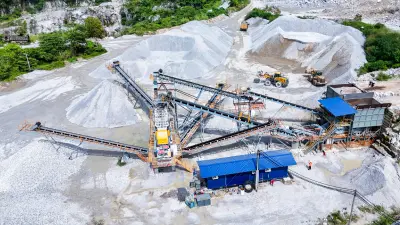
Mobile Crushing and Screening Plant
Tire-mounted and crawler-mounted crushing plants for quarries that move, contract crushing and construction waste, from 100 to 400 t/h in a single transportable unit.

A mobile plant is not a small fixed plant on wheels. The economics are completely different: you are not buying capacity, you are buying the ability to be somewhere else next month without paying for a new foundation. That changes what matters — transport weight, setup time and the ability to run without a grid connection matter more than the last 5% of throughput.
Tire-mounted or crawler
Tire-mounted units are cheaper, tow faster on road and suit quarries with flat, prepared ground. Crawler units are heavier and slower to move but work on benches, in tunnels and on demolition sites where a wheeled unit cannot stand. For most quarry operators the answer is a tire-mounted jaw unit plus a tire-mounted screen, with a crawler unit added only when the site demands it.
| Tire-mounted | Crawler-mounted | |
|---|---|---|
| Transport | Tow at 40 km/h, no permit under 4 m width | Low-bed trailer, permit required |
| Setup time | 2-4 hours with jacks and chocks | 30-60 minutes, self-propelled |
| Ground | Level, compacted | Any, including 15 degree slope |
| Cost | Baseline | 1.4-1.7x |
| Best for | Quarries, contract crushing | Tunnels, demolition, deep pits |
Process flow
Primary unit
A mobile jaw station with a 1,000 x 700 mm feed opening and an independent 3.5 m2 pre-screen. The pre-screen is what separates a usable mobile plant from a frustrating one: bypassing the minus 40 mm fraction before the crusher adds 25-40% effective capacity and stops the jaw from choking on wet fines.
Secondary unit
Either a mobile impactor for limestone and recycling, or a mobile cone for hard rock. Both are available with a closed-circuit return conveyor, which turns the unit into a self-contained production plant making a single sized product.
Screening unit
A three-deck mobile screen at 6 x 1.8 m, with hydraulic folding conveyors. The critical detail is the stockpile height: at 4.2 m the conveyors make 1,800 m3 stockpiles, which is enough for a day of truck loading without re-handling.
Power options
A diesel generator set on board gives complete independence at about 0.6 L per tonne of product. An electric drive with a cable reel costs 40% less to run but tethers the plant to a connection. Most contract crushers choose the dual option: electric in the quarry, diesel on site.
Where mobile plants win
Contract crushing at 150,000 t per site, quarry bench development where the face moves 300 m a year, tunnel projects where the muck never leaves the portal, and demolition sites where the material must be processed in place. In each case the fixed plant alternative loses on haulage, not on capital.
Questions we are asked before quoting
How many tonnes can one plant move per month?
A single jaw-plus-screen combination at 200 t/h running 12 hours a day delivers 55,000-65,000 t per month including moves and maintenance.
Can it run on a single-phase supply?
No. Mobile plants draw 200-400 kW and need three-phase. Where only single-phase is available, the diesel option is the only route.
Other solution categories
Same engineering team, different process route.