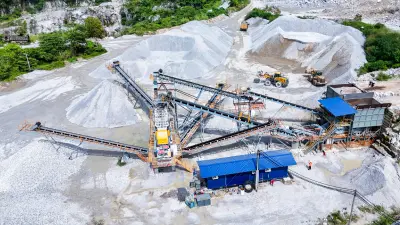
Asphalt Aggregate Production Line
Asphalt mixes reject flat and elongated particles. Why a cone plus VSI circuit beats impact alone, the sand equivalent that decides the fines, and the washing that keeps it above 55.

Asphalt is the most demanding aggregate customer in the construction market. A wearing course carries a specification on flakiness index below 25-30%, sand equivalent above 50-55, and a gradation held within a few percent across five or six sieve sizes. An aggregate plant that supplies ready-mix concrete will usually fail an asphalt specification on shape alone, because the impact crusher that gives good production also gives flat particles.
Shape is made in the third stage
| Crusher | Flakiness | Fines | Role |
|---|---|---|---|
| Jaw | 30-40% | Low | Primary only |
| Cone | 20-30% | Medium | Secondary, good shape |
| Impact (HSI) | 10-18% | High, 25-35% | Secondary or tertiary, best shape |
| VSI | 8-15% | Very high, 30-40% | Tertiary shaping |
The standard circuit for asphalt aggregate is jaw, cone, and then a VSI in closed circuit on the 10-25 mm stream. The VSI breaks particles by rock-on-rock impact, which snaps the weak elongated pieces and leaves cubical ones. It also generates 30-40% fines, and those fines have to go somewhere — into the manufactured sand product if the specification allows, or into a waste pile that grows faster than the operator expected.
Process flow
Primary and secondary
A jaw crusher reduces run-of-quarry limestone or granite to 150 mm, and a cone crusher takes it to 40 mm. For hard rock above 200 MPa a cone is the only economic choice for the secondary stage; for limestone an impact crusher can do the secondary work and give a better shape at the same time.
Tertiary shaping
The VSI runs in closed circuit with a screen at 25 mm. Rotor speed is the control lever: higher speed gives better shape and more fines, lower speed gives more capacity. Most plants find the economic optimum at 55-70 m/s and accept a flakiness of 12-16%, which clears the 25% limit with margin for the day the feed gets more weathered.
Washing and the sand equivalent
Sand equivalent measures how much clay is in the fine fraction, and asphalt mixes set it at 50-55 because clay coats the aggregate and prevents the bitumen from bonding. A spiral washer plus a fines dewatering screen removes the minus-75-micron clay. Washing also removes the dust that makes the plant unpleasant to work in, which is a permitting issue in most countries.
Grading and blending
Asphalt plants buy discrete sizes and blend them. Five or six product bins with separate stockpiles are normal, and the bins have to be designed against segregation — a single 20 mm drop into a cone pile segregates the coarse fraction to the outside and gives a stockpile that varies across its face. Chute-and-baffle systems or a telescopic conveyor are worth more than a bigger screen.
Equipment list
| Stage | Equipment | Specification |
|---|---|---|
| Feeding | Vibrating feeder + grizzly | 400 t/h |
| Primary | Jaw crusher PE-750x1060 | To 150 mm |
| Secondary | Cone crusher, medium cavity | To 40 mm |
| Tertiary | VSI, 55-70 m/s | Closed circuit at 25 mm |
| Screening | Vibrating screen, 4 decks | 5 sizes |
| Washing | Spiral washer + dewatering screen | Sand equivalent above 55 |
| Dust | Bag filter on all transfer points | 20 mg/m3 |
Filler and the minus-75 fraction
Asphalt mix design uses mineral filler passing 75 micron, and the baghouse dust from the aggregate plant is an acceptable source if it is not contaminated. Selling the dust to the asphalt plant instead of dumping it turns a disposal cost into a small revenue line, and it needs nothing more than a separate collection bin under the bag filter.
Questions we are asked before quoting
Can I make asphalt aggregate without a VSI?
With a good cone in a choke-fed cavity you can reach 20-25% flakiness, which passes some specifications. If the local authority tests flakiness on the coarse fraction strictly, the VSI is the safe route.
What proportion of the output is usable?
60-75% for a well-designed asphalt circuit. The rest is manufactured sand (saleable), filler (saleable to the asphalt plant) and surplus fines.
Other solution categories
Same engineering team, different process route.