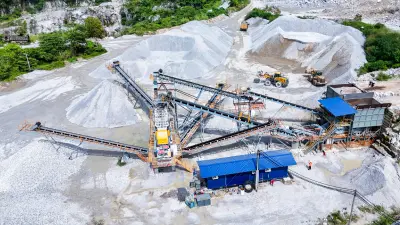
Mine Waste Rock Aggregate Line
Waste rock is 40-90% of what a mine moves and it is already blasted, loaded and hauled. Turning it into saleable aggregate, with the acid drainage and sulphate tests that decide whether it can be sold.

A metal mine moves 40-90% of its total tonnage as waste rock, blasts it, hauls it to a dump, and spends money on the dump's stability and drainage for the life of the mine and beyond. That rock is already fragmented to below 800 mm and sits on the surface. The question is not whether it can be crushed into aggregate — it can — but whether its chemistry allows the aggregate to be sold and used.
The tests that decide everything
| Test | Limit for sale | Consequence of failing |
|---|---|---|
| Acid base accounting | Net neutralising, NAPP below zero | Product causes acid drainage in service |
| Sulphide sulphur | Below 1% | Expansion, staining, sulphate attack |
| Alkali-silica reactivity | Non-reactive | Concrete cracking years later |
| Los Angeles abrasion | Below 40% | Not accepted for road base |
| Free silica | Respirable quartz assessed | Worker health obligation |
Acid base accounting is the one that ends projects. A waste rock with 2% pyritic sulphur and no carbonate neutralising capacity will oxidise in a stockpile and leach acid for decades. Crushing it into a road base spreads that reaction over a much larger surface area. If the rock fails the ABA test, the only viable product is a fully encapsulated use or a return to the dump.
Process flow
Feed and primary crushing
Waste rock from a blast is 0-800 mm with a high proportion of fines and clay, and it is often wet. An apron feeder with a grizzly scalper bypasses the minus-80 mm to a separate stream, which is usually too clay-rich for aggregate but can go to road fill. The jaw crusher should be sized on the 800 mm lumps with a hydraulic release, because untouched oversize from a mine blast is common.
Secondary and product sizing
Either a cone crusher for hard abrasive rock or an impact crusher for softer rock. Screening at 40, 20 and 5 mm produces the three standard products. A washing stage is usually needed because mine waste carries clay from the blast and from the dump surface, and clay in a road base lowers the bearing capacity.
Placement advantage
The economics of a waste rock plant are better than a quarry plant in one specific way: the rock is already blasted and on the surface, so there is no drilling, no blasting, no overburden removal, and often no new haul road. Processing cost is 3-6 USD per tonne against 6-10 for a greenfield quarry. The advantage disappears if the dump is more than 5-8 km from the market, because aggregate is a low-value, high-mass product and transport dominates.
Equipment list
| Stage | Equipment | Specification |
|---|---|---|
| Feeding | Apron feeder + grizzly | 1,000 t/d, 800 mm |
| Primary | Jaw crusher, hydraulic release | To 120 mm |
| Secondary | Cone crusher | To 40 mm |
| Screening | Vibrating screen, 3 decks | 0-5, 5-20, 20-40 mm |
| Washing | Spiral washer + dewatering | Removes clay and fines |
| Dust control | Water sprays and bag filter | Respirable silica control |
| Rejects | Return conveyor to dump | Oversize and contaminated |
Co-disposal and the closure credit
The strongest business case for a waste rock plant is often not the aggregate revenue but the closure liability. A mine that processes 20% of its waste rock into saleable product and backfills the plant fines into the pit reduces the volume of the remaining dump, cuts the long-term drainage treatment obligation, and gets a credit against its rehabilitation bond. In several jurisdictions that credit is worth more than the aggregate margin, and it is the argument that gets the project approved internally.
Questions we are asked before quoting
Does the product need certification?
For structural use, yes, and the certification body will ask for the ABA and ASR results before anything else. Budget six to twelve months for testing and approval.
Can I process waste rock at the mine and sell it on site?
That is the best model. Hauling aggregate more than 30 km rarely pays, but a mine with its own haul road and a captive market in the local construction industry has a structural cost advantage.
Other solution categories
Same engineering team, different process route.