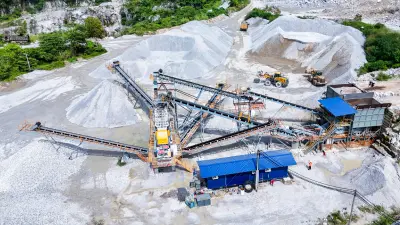
Cement Grinding Station (OPC and PPC)
Import clinker, grind, sell cement. The mill configuration, the Blaine target and the supplementary cementitious material choice that decide whether the station makes money.

A grinding station is the lowest-capital entry into the cement business: buy clinker, grind it with gypsum and a supplementary material, sell cement. The capital is 15-20% of an integrated line and the construction time is 12-14 months instead of 36. The catch is that the entire margin sits in power consumption and in how much clinker you can replace without failing the strength test.
Three mill configurations
The choice sets the power bill for twenty years.
| Configuration | Power at 350 m2/kg | Capacity | Capital |
|---|---|---|---|
| Ball Mill, open circuit | 38-45 kWh/t | 30-60 t/h | Lowest |
| Ball mill, closed circuit with separator | 32-38 kWh/t | 50-120 t/h | Low |
| Roller press + ball mill | 26-30 kWh/t | 80-180 t/h | Middle |
| Vertical Roller Mill | 22-26 kWh/t | 100-250 t/h | Highest |
A vertical roller mill saves 10-15 kWh per tonne against a closed-circuit ball mill. At 500,000 tonnes a year and 0.08 USD per kWh that is 400,000-600,000 USD annually, so the capital premium repays in four to six years. The one reason to stay with a ball mill is product shape: VRM cement has a steeper particle size distribution and can show 1-3 MPa lower 28-day strength at the same Blaine, which some markets penalise.
Process flow
Proportioning
Four to five weigh feeders deliver clinker, gypsum, limestone, fly ash or slag into the mill. The gypsum dose is set by the SO3 target, usually 2.0-2.8% in the finished cement, and it is not a fixed number: the optimum shifts with the C3A content of the clinker, because gypsum exists to control the set of the aluminate phase. A station that doses 5% gypsum by habit is wasting money and risking expansion.
Grinding temperature
The mill outlet must stay between 95 and 120 C. Above 130 C the gypsum loses its water of crystallisation and becomes soluble anhydrite, which causes flash set that the customer discovers on site. Below 90 C the cement carries moisture into the silo and cakes on the walls. A water spray in the mill and a controlled ventilation rate are the two levers; most stations need both.
Classification and the Blaine target
Blaine is the number the market buys, but the residue on 45 micron is the number that governs strength. Grinding to 350 m2/kg with 12% residue is a different product from 350 m2/kg with 6% residue, and the second costs 5-7 kWh more per tonne. Before fixing the target, ask what the local standard and the local ready-mix plants actually test.
Equipment list
| Stage | Equipment | Specification |
|---|---|---|
| Storage | Clinker shed, 20,000 t | Covered, with reclaim |
| Dosing | 4 weigh feeders | Plus 2 for SCM |
| Grinding | VRM, 4,000 mm table | 150 t/h at 350 m2/kg |
| Separation | High-efficiency dynamic | 45 micron residue 6-12% |
| Collection | Bag filter | 99.9%, 10 mg/m3 |
| Storage | Two silos, 5,000 t each | Air pads, 60 degree cone |
| Dispatch | Bulk loader + 8-spout packer | 1,200 bags per hour |
The clinker factor is where the margin is
Clinker is the most expensive component. Replacing 25% of it with fly ash or limestone lowers the cost per tonne of cement by 15-20% while adding 8-12% to the grinding power, because both materials are softer but the product has to reach the same Blaine. The limit is the strength standard: PPC at 30% fly ash typically reaches 42.5 MPa at 28 days, and pushing the replacement higher requires either a finer grind or a higher-strength clinker. Every station should model this trade before fixing the product mix.
Questions we are asked before quoting
Can I add slag to the same mill?
Yes, but grind it separately or in campaigns. Slag needs 420-450 m2/kg and consumes 40% more power per tonne; blending it in the same pass gives an unpredictable product.
How much clinker storage do I need?
Three to four weeks of production. Clinker arrives by ship or truck in large lots and a station that runs out mid-vessel pays spot prices for the difference.
Other solution categories
Same engineering team, different process route.