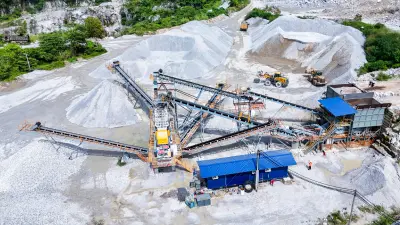
Dead Burned Magnesia Production Line
Magnesite to dead burned magnesia at 1,700-1,900 C: the crystal growth that decides hydration resistance, the kiln types that reach it, and the fusion route for high-purity grades.

Dead burned magnesia is sold on a property you cannot see: the size of the periclase crystal. A DBM at 3.25 g/cm3 bulk density with 80 micron crystals resists hydration for months in a ladle lining; the same chemistry at 25 micron crystals cracks within weeks. Crystal growth needs temperature and time, which means the kiln is the product specification.
Three grades and how they are made
| Grade | Process | MgO | Crystal size |
|---|---|---|---|
| Caustic calcined magnesia | 750-1,000 C, shaft or rotary kiln | 80-92% | Not sintered |
| Dead burned (DBM) | 1,700-1,900 C, rotary or shaft kiln | 90-96% | 40-100 micron |
| Fused magnesia | Electric arc furnace, above 2,800 C | 97-99% | 200-1,000 micron |
The first step is always a caustic calcination to drive off CO2, because feeding raw magnesite at 15-25% loss on ignition directly into a sintering kiln makes the kiln a gas generator. Two-stage processing — light burn at 900-1,100 C, then dead burn at 1,750 C — gives a denser product than a single pass, because the shrunk and hardened caustic grain sinters more uniformly.
Process flow
Ore preparation
Magnesite is crushed to 10-40 mm for a rotary kiln or 30-60 mm for a shaft kiln, and screened to a narrow band. Silica is the impurity that hurts most: above 2.5% SiO2 the silica forms forsterite with the magnesia and the refractory's hot strength collapses. Iron and calcium are fluxes that help densification at low grade and hurt corrosion resistance at high grade, so the ore body dictates the product, not the kiln.
Sintering
A rotary kiln at 1,750-1,900 C with a basic refractory lining and 2-3 hours in the sintering zone is the conventional route for 30-300 t/d. Residence time is the variable most plants get wrong: cutting it to raise output drops the bulk density from 3.25 to 3.10 g/cm3, which is a different product at a lower price. A shaft kiln is more fuel efficient but the temperature profile is harder to control and the product is less uniform.
Cooling and handling
Slow cooling from 1,750 C to below 200 C in a rotary cooler, then crushing and screening to the customer's size fractions. Dead burned magnesia must not be quenched: thermal shock cracks the crystals and the hydration resistance falls. The finished product is packed in moisture-barrier bags or shipped in bulk in sealed containers.
Equipment list
| Stage | Equipment | Specification |
|---|---|---|
| Crushing | Jaw + roll crusher | To 30 mm |
| Light burn | Rotary kiln 2.2 x 50 m | 150 t/d at 1,000 C |
| Sintering | Rotary kiln 3.2 x 80 m | 100 t/d at 1,800 C |
| Refractory | Magnesia-chrome or magnesia-spinel brick | Sintering zone |
| Cooling | Rotary cooler | Slow cool, no quench |
| Crushing | Jaw crusher to 5-50 mm | Screened into 4 fractions |
| Packing | Jumbo bags + 25 kg bags | Moisture barrier liner |
Where fused magnesia fits
For steelmaking ladle and converter linings the specification often demands fused magnesia at 97-99% MgO with crystals of hundreds of microns. That product comes from an electric arc furnace melting dead burned or calcined magnesia at 2,800 C, which is a power-intensive route at 2,500-3,500 kWh per tonne. A DBM plant can supply the feed for a fusion operation, but the two are separate businesses with separate economics.
Questions we are asked before quoting
Can I go straight from raw magnesite to DBM in one kiln?
It is possible and it is what small plants do, but the product is 0.1-0.15 g/cm3 lighter and less hydration resistant. Two-stage processing is what separates a refractory-grade product from a metallurgical one.
What fuel does the sintering kiln need?
Coal, heavy oil, or natural gas at 1,750-1,900 C. Fuel consumption is 250-400 kg of coal equivalent per tonne of DBM, which is high enough that fuel price, not ore price, decides where the plant is built.
Other solution categories
Same engineering team, different process route.