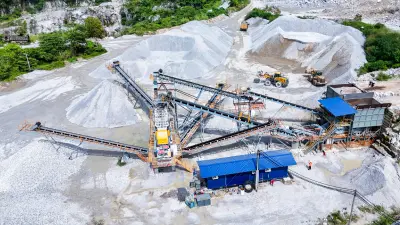
Gypsum Calcination and Powder Line
Gypsum is bought on setting time, not on purity. How the calcination temperature decides hemihydrate versus anhydrite, and why kettle, rotary and FC calcination are not interchangeable.

Gypsum processing is one of the few mineral businesses where the specification is a rate rather than a number. The customer buys setting time: a plaster that sets in 8 minutes and one that sets in 40 minutes are both 92% CaSO4.2H2O, and they come from the same ore with the same mill. The difference is the calcination temperature and how long the material spent in the transition zone.
The three dehydration steps
| Product | Temperature | Water of crystallisation | Behaviour |
|---|---|---|---|
| Dihydrate (raw) | Below 100 C | 2 H2O | Inert, no set |
| Hemihydrate (beta) | 150-180 C | 0.5 H2O | Normal plaster, 8-25 min set |
| Hemihydrate (alpha) | 120-140 C, wet or pressure | 0.5 H2O | High strength, lower water demand |
| Soluble anhydrite | 200-400 C | 0 | Slow set, can flash set if mixed with hemihydrate |
| Dead burned anhydrite | Above 500 C | 0 | No set without an activator |
Everything in a gypsum plant is about stopping the reaction at the hemihydrate stage. Over-calcine by 30 C and part of the product becomes soluble anhydrite, which absorbs moisture from the air in storage and reverts to hemihydrate on the wall of the silo — and that reverted material sets in two minutes when the customer mixes it.
Three calcination technologies
| Technology | Capacity | Product | Notes |
|---|---|---|---|
| Kettle (cooker) | 5-25 t/h per batch | Beta hemihydrate, consistent | Batch, easy to control, most common for plaster |
| Rotary kiln | 5-40 t/h | Beta, broader distribution | Continuous, tolerates mixed feed, more over-burn |
| Flash calciner (FC) | 10-50 t/h | Beta, very uniform | Fast, needs dry and finely ground feed |
| Autoclave (alpha) | 2-10 t/h | Alpha hemihydrate | High strength, higher capital |
Process flow
Crushing and grinding
Rock gypsum or synthetic gypsum from a power station FGD arrives at 10-25 mm and 5-15% moisture. A hammer crusher reduces it below 20 mm, then a Raymond Mill or a ring-roll mill grinds to 120-200 mesh. In a kettle plant the grinding can happen before or after calcination; grinding before is more common because the fine powder calcines uniformly in 60-90 minutes.
Calcination
In a kettle, the ground gypsum is heated indirectly through a jacket to 150-170 C and stirred for 1.5-3 hours. The end point is judged by the loss on ignition, which should be 5.5-6.5% for a standard plaster. A rotary kiln passes the material through a hot gas stream at 400-600 C with 20-40 minutes residence; it is more forgiving on feed quality but produces a wider distribution of dehydration states, which is why rotary-calcined plaster often needs 3-7 days of ageing in a silo before packing.
Ageing, which nobody budgets for
Freshly calcined hemihydrate is metastable. During ageing, the soluble anhydrite rehydrates to hemihydrate and the temperature equalises, and the setting time stabilises. A plant without an ageing silo ships plaster whose set time drifts by a factor of two between the first bag and the last bag of the same batch. Budget 3-7 days of silo capacity, and do not skip it to shorten the order cycle.
Equipment list
| Stage | Equipment | Specification |
|---|---|---|
| Crushing | Hammer crusher | To 20 mm, 25 t/h |
| Grinding | Raymond mill 4R | 12 t/h at 150 mesh |
| Calcination | Kettle, 15 t per batch | 160 C, indirect heating |
| Dust collection | Bag filter | 99.5% |
| Ageing | Silo, 3-7 days capacity | Insulated |
| Packing | Valve packer, 25 kg | Plus bulk for plaster plants |
Synthetic gypsum is not rock gypsum
FGD gypsum and phosphogypsum are chemically gypsum and physically different. FGD gypsum is fine, wet, and uniform and calcines well in a flash calciner. Phosphogypsum carries phosphate and fluoride impurities that retard set and need washing or neutralisation before calcination. Titanogypsum carries free sulphuric acid. Buying a cheap synthetic gypsum without a full analysis is the most common way a new plaster plant fails its first customer trial.
Questions we are asked before quoting
Can one line make plaster and gypsum board grade?
Yes, with different grinding fineness and a tighter calcination control. Board-grade stucco needs a more consistent set time because the board line runs continuously and a batch that sets early stops the line.
What purity do I need in the raw gypsum?
Above 85% CaSO4.2H2O for plaster, above 90% for board. Above 3% clay the plaster loses strength; above 0.5% chloride the steel in the board line corrodes.
Other solution categories
Same engineering team, different process route.