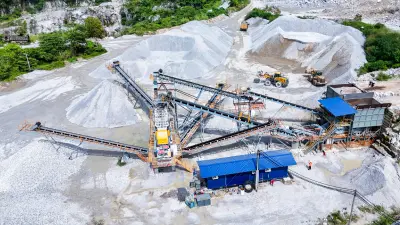
Phosphate Rock Beneficiation Line
Phosphate ore is bought on P2O5 and rejected on MgO and Fe2O3. Washing, scrubbing, magnetic separation and the flotation circuit that handles the fine fraction.

Phosphate rock is the raw material for fertiliser and there is no substitute for it, which makes it a commodity with an unusually stable demand and an unusually technical specification. The buyer is a phosphoric acid plant, and that plant cares about three things: P2O5 content, the ratio of CaO to P2O5, and the penalties for magnesium, iron, aluminium and chloride. Beneficiation exists to move those numbers into the acceptable band.
Two ore types, two circuits
| Property | Sedimentary (phosphorite) | Igneous (carbonatite) |
|---|---|---|
| P2O5 in ore | 15-25% | 4-15% |
| Main gangue | Quartz, clay, carbonate | Apatite in magnetite or carbonate |
| Route | Wash, screen, flotation | Magnetic, gravity, flotation |
| Hardest impurity | MgO from dolomite | Iron and carbonate |
Sedimentary ore is the bulk of world production and the circuit is dominated by removing carbonate and clay. Igneous ore is coarser and simpler to liberate but often carries magnetite that can be a by-product.
Process flow
Washing and scrubbing
Most sedimentary phosphate arrives with 10-25% clay. A scrubber plus a wet screen at 1-2 mm removes it and lifts P2O5 by 3-6 points at very low cost, which is why washing is always the first unit in the flowsheet. The underflow goes to a thickener; the slime is a disposal problem because phosphate slime settles slowly and occupies large volumes.
Carbonate removal
Dolomite is the impurity that ends the sale. Above 1% MgO in the concentrate, the acid plant's consumption of sulphuric acid rises and the filtration of gypsum becomes difficult. Two routes: reverse flotation of dolomite with a fatty acid collector at pH 5-6, or a gravity/heavy-media pre-concentration that exploits the density difference between apatite at 3.2 and dolomite at 2.85. For coarse liberation, heavy media works well and is cheaper than flotation.
Flotation of the fine fraction
Direct flotation of apatite with a fatty acid or a hydroxamate collector at pH 9-10 in alkaline circuits; reverse flotation of quartz with an amine at pH 7-8 in acidic circuits. The choice depends on the gangue. Flotation cells are fed at 25-35% solids with a conditioning time of 3-5 minutes; a rougher, a scavenger and two cleaners give 85-90% recovery at 30-32% P2O5.
Dewatering
Phosphate concentrate is thixotropic and filters slowly. A high-rate thickener plus a filter press, or a disc filter with steam assistance, brings it to 10-12% moisture. Above 14% moisture the product cakes in the ship's hold and the freight is paid on water.
Equipment list
| Stage | Equipment | Specification |
|---|---|---|
| Primary | Jaw crusher | To 100 mm |
| Scrubbing | Attrition scrubber | 10 minutes, 60% solids |
| Screening | Wet vibrating screen | 1.5 mm cut |
| Magnetic | WHIMS, 12,000 gauss | For igneous ore |
| Flotation | Rougher + scavenger + 2 cleaners | 30-35% solids, pH 9-10 |
| Dewatering | Thickener + filter press | Below 12% moisture |
| Water | Tailings thickener, closed loop | 85% recovery |
Cadmium and the fertiliser market
Sedimentary phosphate carries cadmium at 5-60 ppm depending on the deposit, and the European fertiliser regulation limits cadmium in phosphate fertiliser to 60 mg/kg P2O5, moving toward 20 in some member states. Beneficiation does not remove cadmium, because it substitutes into the apatite lattice. If the destination market is Europe, test the cadmium before anything else — a deposit that fails that test fails regardless of how good the P2O5 grade is.
Questions we are asked before quoting
Can I produce 32% P2O5 from a 20% ore?
Yes, with a combination of washing, flotation and often a magnetic stage, at a recovery of 80-88%. The limit is usually the MgO specification rather than the P2O5 grade.
Is calcination an option?
For high-carbonate ore, a calcination step at 800-900 C drives off CO2 and burns organics, which can lift P2O5 by 8-12 points. It is expensive in fuel and only justified where flotation cannot meet the MgO limit.
Other solution categories
Same engineering team, different process route.